- Página de inicio /
- Libros /
- Engineering & Transportation /
- Engineering /
- Electrical & Electronics /
- Electrónica /
- Sensors /
- Autonomous Vehicle Lidar: A Tutorial
0 ratings

Nº de artículo:
41474947
Autonomous Vehicle Lidar: A Tutorial
Nº de artículo:
41474947
NIO 1286
Price Details
Excluding Shipping & Custom charges ( Shipping and custom charges will be calculated on checkout )
*All items will import from Estados Unidos
0 ratings
Escribe una opinión
En stock
 Importado de la tienda USA
QTY:
Haz tu pedido ahora y recíbelo por ahí Miércoles, Agosto 05
Secured transaction
Ubuy works hard to protect your security and privacy. Our advanced payment security system ensures confidentiality by encrypting your information during transmission using AES (Advanced Encryption Standards) and SSL (Secure Socket Layer) protocols. Your payment details are 100% secure as we do not share your payment details with third party sellers.
Our Top Logistics Partners


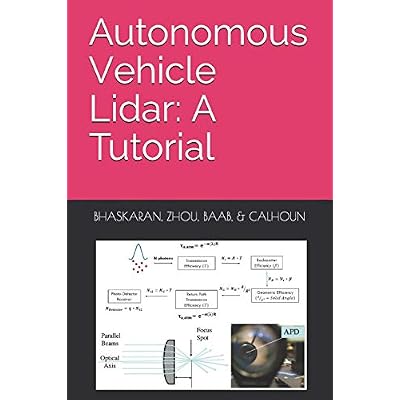
This tutorial text aims to introduce a technical but nonspecialist reader to autonomous vehicle lidar, starting from the fundamental physics of lidar and motivation for its application to autonomous vehicle systems.

Fast
Shipping

Free
Return*

Secure Packaging

100% Original Products

PCI DSS Compliance

ISO 27001 Certified


What Stands Out
Enhanced Accuracy
Offers precise environmental mapping using advanced laser technology, ensuring reliable navigation and obstacle detection, which significantly improves safety in autonomous vehicles.
Real-time Processing
Processes data instantly to allow vehicles to adapt to changing surroundings, enabling immediate responses to dynamic driving conditions and enhancing overall driving intelligence.
User-friendly Interface
Designed with accessibility in mind, providing intuitive controls and clear visualizations for developers, making it simpler to integrate and operate within autonomous systems.
Detalles de producto
| Publisher | Independently published |
| Publication date | December 31, 2019 |
| Language | English |
| Print length | 107 pages |
| ISBN-10 | 1653277912 |
| ISBN-13 | 978-1653277919 |
| Item Weight | 5.9 ounces (167.27 grams) |
| Dimensions | 6 x 0.27 x 9 inches (15.2 x 0.7 x 22.9 cm) |
Who Should Buy?

-
Engineering Students
Students pursuing degrees in engineering can gain foundational knowledge on LIDAR technology used in autonomous vehicles.
-
Industry Professionals
Professionals in automotive and robotics sectors can enhance their understanding of LIDAR applications and integration techniques.
-
Hobbyist Developers
Independent developers and hobbyists interested in DIY autonomous projects will find useful insights and practical examples in this tutorial.

-
General Consumers
Everyday consumers seeking basic information about autonomous vehicles may find this tutorial overly technical and complex.
DESCRIPCIÓN DEL PRODUCTO
Autonomous Vehicle Lidar: A Tutorial
¿Tienes alguna consulta? Chatea con nosotros
Preguntas y respuestas de los clientes
-
Pregunta:
What is Lidar and how does it work in autonomous vehicles?
Respuesta: Lidar, which stands for Light Detection and Ranging, is a technology that uses laser light to measure distances. In autonomous vehicles, Lidar systems emit pulses of laser light and measure the time it takes for the light to reflect off objects and return. This process creates a precise 3D map of the vehicle's surroundings, allowing it to detect obstacles, lane markings, and other vital features necessary for safe navigation. -
Pregunta:
What are the key benefits of using Lidar in autonomous vehicles?
Respuesta: The main benefits of Lidar include high precision, long-range detection, and the ability to create detailed 3D representations of the environment. This accuracy enables autonomous vehicles to make informed decisions in real time, enhancing safety and efficiency. Additionally, Lidar can operate effectively in various lighting conditions, unlike traditional cameras that may struggle at night or in bright sunlight. -
Pregunta:
How does Lidar compare to other sensors used in autonomous vehicles?
Respuesta: Lidar offers distinct advantages over other sensors like radar and cameras, particularly in terms of spatial resolution and object detection capabilities. Unlike cameras, Lidar collects accurate distance information, which is crucial for identifying and categorizing objects. Radar, while robust in detecting objects, lacks the fine detail that Lidar provides, thus making Lidar a preferred choice for comprehensive environmental mapping. -
Pregunta:
Can Lidar systems be affected by weather conditions?
Respuesta: Yes, Lidar systems can be impacted by adverse weather conditions, especially heavy rain, fog, or snow. These conditions can scatter the laser light, reducing detection accuracy. However, advancements in Lidar technology are continually being developed to enhance performance in less than optimal weather scenarios, making systems more reliable in various environments, ultimately improving safety for autonomous driving. -
Pregunta:
What types of Lidar systems are commonly used in autonomous vehicles?
Respuesta: There are two primary types of Lidar systems: solid-state Lidar and mechanical Lidar. Solid-state Lidar uses electronic components to scan the environment, offering simpler, more compact designs with reduced moving parts. Mechanical Lidar, on the other hand, employs rotating mirrors or similar technology to achieve a complete field of view. Each type has its advantages, so manufacturers select based on specific applications and desired performance characteristics. -
Pregunta:
What role does Lidar play in the development of self-driving cars?
Respuesta: Lidar plays a critical role in the development of self-driving cars by enabling these vehicles to perceive their surroundings accurately. This capability is crucial for tasks like obstacle detection, lane keeping, and navigation. Manufacturers rely on the data generated by Lidar systems to refine their algorithms and improve the overall efficiency and safety of autonomous driving technologies, ensuring a seamless driving experience. -
Pregunta:
How is data from Lidar processed for vehicle navigation?
Respuesta: Data from Lidar is processed using sophisticated algorithms that analyze the 3D point clouds generated. This involves filtering noise, identifying objects, and determining distances. The processed data is then integrated with information from other sensors, such as cameras and radar, to create a cohesive understanding of the vehicle's environment. This integration allows autos to navigate safely and efficiently through various driving conditions. -
Pregunta:
What are the limitations of Lidar technology in autonomous driving?
Respuesta: While Lidar is robust, it does have limitations. Its effectiveness can decrease in certain weather conditions, and it may struggle to recognize certain materials or objects that do not reflect laser light effectively. Additionally, there is a significant cost associated with high-quality Lidar systems, which can be a barrier to widespread adoption in lower-cost vehicle models. Despite these challenges, ongoing research continues to enhance Lidar technology. -
Pregunta:
Can Lidar be integrated with other technologies for enhanced vehicle performance?
Respuesta: Yes, integrating Lidar with other technologies like cameras, radar, and artificial intelligence (AI) enhances overall vehicle performance. This fusion of data allows for a more comprehensive perception of the environment, addressing the individual limitations of each technology. Such integration is essential to the advancement of autonomous systems, enabling vehicles to make informed decisions during complex driving scenarios. -
Pregunta:
Where can I buy Autonomous Vehicle Lidar: A Tutorial in Nicaragua?
Respuesta: You can purchase Autonomous Vehicle Lidar: A Tutorial at Ubuy. They offer a wide selection of educational and technical resources, ensuring you can find the right materials for your needs. Ubuy stands out for its user-friendly platform and reliable customer service, making it a preferred option for acquiring specialized items in your Nicaragua.
Sensors Editorial Review
No se encontraron reseñas editoriales
Customer Reviews & Ratings
1 valoraciones de los clientes
-
5 estrella
100%
-
4 estrella
0%
-
3 estrella
0%
-
2 estrella
0%
-
1 estrella
0%
Revisar este producto
Comparte tus ideas con otros clientes
Platform Trust & Buyer Confidence

MA
Mohammad
Verified buyer
“Excellent quality and original too,when ubuy send original things I will appreciate that ,I very satisfied thank you”
23 July 2026 · via Trustpilot
CK
Chitra
Verified buyer
“The order and delivery progress was communicated very well. Package arrived within the estimated time. Products arrived as expected in good condition.”
22-Jul-26 · via Trustpilot
K
kund
Verified buyer
“Good supply of products. Safe payment methods, and shipment worldwide! Genuine products.”
23-Jul-26 · via Trustpilot
OO
Onesi
Verified buyer
“Was my first time buying a product from Ubuy, but I found it so helpful. This is reliable. Gonna place a new order!”
22 July 2026 · via Trustpilot
SJ
SAO JOHN
Verified buyer
“Ubuy is a great online platform to buy stuff. Reliable, fast delivery time and great value for money. I've been using Ubuy online shopping platform for three years now and will continue to do so.”
23 July 2026 · via Trustpilot
Pago seguro
Global Delivery
Easy Returns
Genuine Products
Product Price History
Información importante
- Limitaciones: Para los productos enviados al extranjero, ten en cuenta que cualquier garantía del fabricante puede no ser válida; las opciones de servicio del fabricante pueden no estar disponibles; los manuales del producto, las instrucciones y las advertencias de seguridad pueden no estar en los idiomas del país de destino; los productos (y los materiales que los acompañan) pueden no estar diseñados de acuerdo con las normas, especificaciones y requisitos de etiquetado del país de destino; y los productos pueden no ajustarse al voltaje del país de destino y a otras normas eléctricas (lo que requiere el uso de un adaptador o convertidor, si procede). El destinatario es responsable de asegurarse de que el producto puede ser importado legalmente al país de destino. Cuando hagas un pedido a Ubuy o a sus filiales, el destinatario es el importador registrado y debe cumplir todas las leyes y normativas del país de destino.
- No todos los productos que aparecen en Ubuy están a la venta, ya que Ubuy es un motor de búsqueda a nivel mundial. Los productos están sujetos a las normas de exportación/comercio.
NIO 1286
Haz tu pedido ahora y recíbelo por ahí Miércoles, Agosto 05
This item is not restrict in my country.(Please click on above link if this item is not restrict in your country, So our team will review and allow.)
QTY:
Secured transaction
PCI DSS compliant and ISO 27001:2022 certified, with encrypted payments and full buyer protection on every order.
Our Top Logistics Partners
Fastest cross-border delivery
características y beneficios
- Comprehensive introduction to autonomous vehicle lidar.
- Covers fundamental physics and applications of lidar technology.
- Explores time of flight design concepts in detail.
- Discusses beam steering and timing methods.
- Designed for both technical readers and non-specialists.
- Prepares readers for laboratory explorations in the field.
Ubuy Assurance
Experience worry-free shopping with 100% original products, PCI DSS-compliant payment security, ISO 27001-certified data protection, the fastest cross-border delivery, free returns *, and secure packaging on every order.